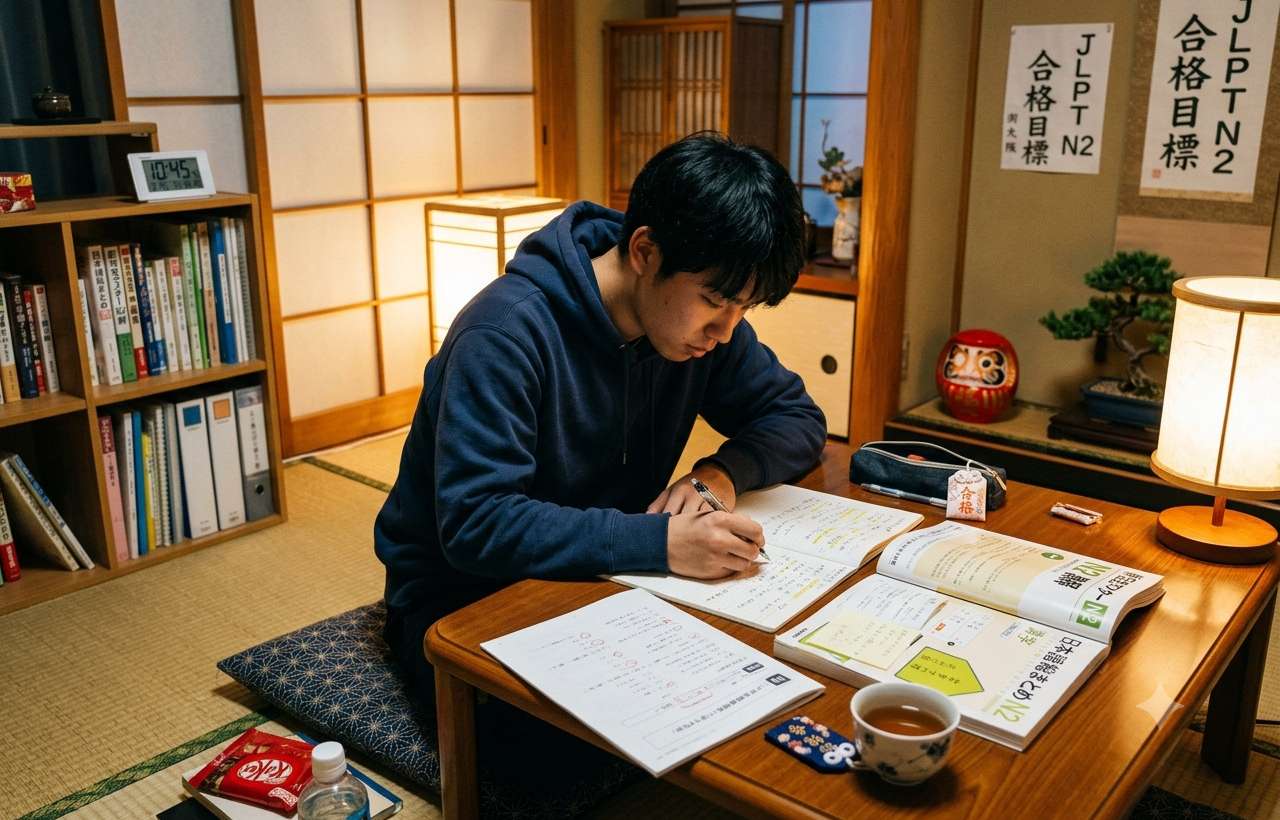
Kanji is always considered the biggest “challenge” for Japanese learners, especially Vietnamese learners who are not familiar with the ideographic writing system. However, with the right learning methods, memorizing hundreds or even thousands of Kanji characters can become much easier and more effective.
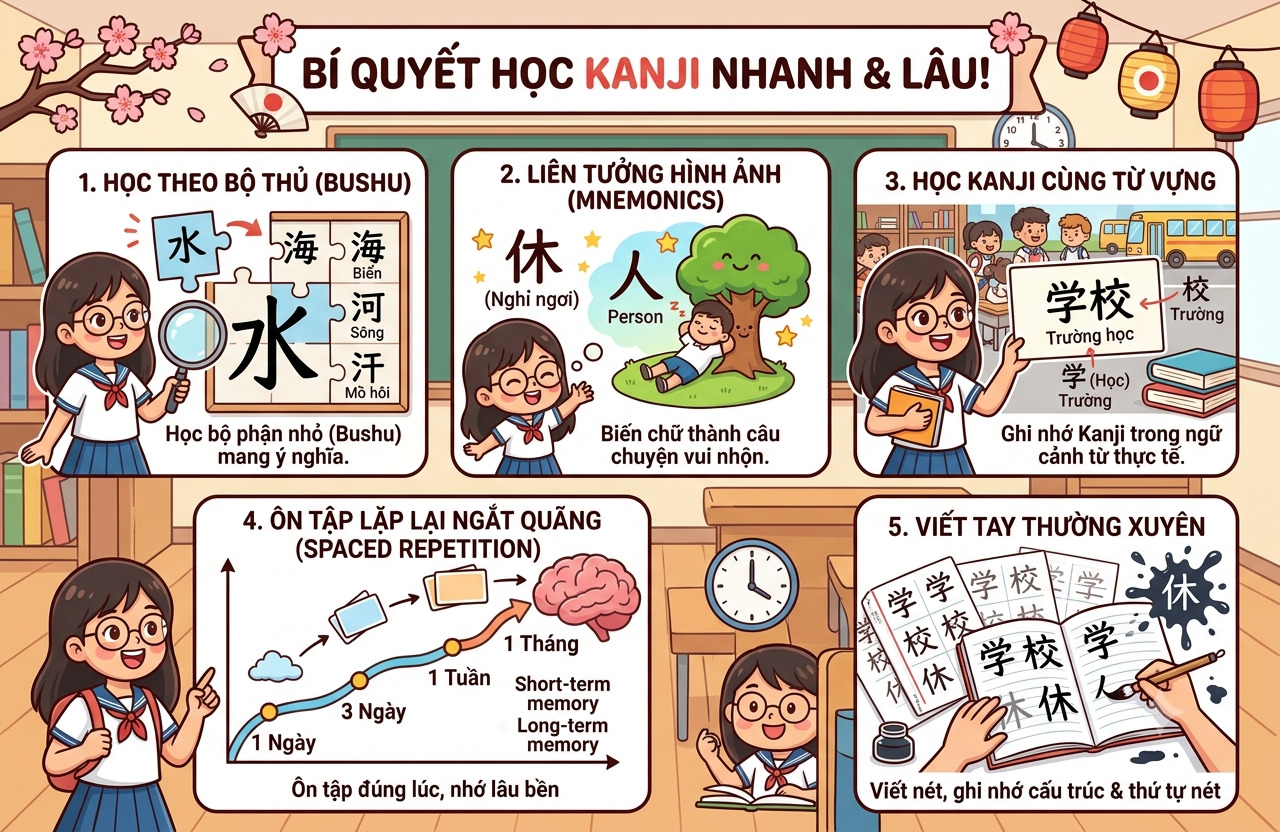
1. Learn by Radicals (Bushu) Instead of Memorizing Individual Characters
Each Kanji character is made up of smaller components called radicals (Bushu), and each radical often carries a specific meaning. For example, the radical 水 (water) frequently appears in characters related to water, such as 海 (sea), 河 (river), and 汗 (sweat).
Understanding the meaning of radicals helps you remember Kanji more easily and even predict the meanings of unfamiliar characters.
2. Use Visual Association and Mnemonics
Turn each Kanji character into a memorable story or image. For example, the character 休 (rest) is made up of 人 (person) and 木 (tree), which can be imagined as a person leaning against a tree to take a rest.
This visual memory method helps the brain retain information longer compared to simple memorization.
3. Learn Kanji Together with Vocabulary
A Kanji character can have different readings depending on how it is combined with other characters. Therefore, it is recommended to learn Kanji together with practical vocabulary.
For example, learn 学校 (school) instead of studying the characters 学 and 校 separately. This approach helps you remember the pronunciation, meaning, and usage of Kanji in real contexts.
4. Review Using Spaced Repetition
The brain quickly forgets information if it is not reviewed at the right time. Apply the Spaced Repetition method by reviewing new Kanji after 1 day, 3 days, 1 week, and 1 month.
This technique helps transfer knowledge from short-term memory into long-term memory more effectively.
5. Practice Writing by Hand Regularly
Although Kanji learning applications are convenient, handwriting still plays an important role in remembering character structures and stroke order.
Spend time writing each new Kanji character about 5–10 times, while combining it with related vocabulary to strengthen memory.
Advice
There is no method that allows you to master all Kanji in a short period of time. The key is to study consistently every day, combine different learning techniques that suit your style, and regularly review what you have learned.
Persistence is the most important factor in conquering Kanji and improving your Japanese ability.